3 Things You Should Know About Rose Medallion
Curio IQ Series: Let’s take a short and sweet lesson in antiques! The 3 things you should know before buying and collecting Rose Medallion porcelains.
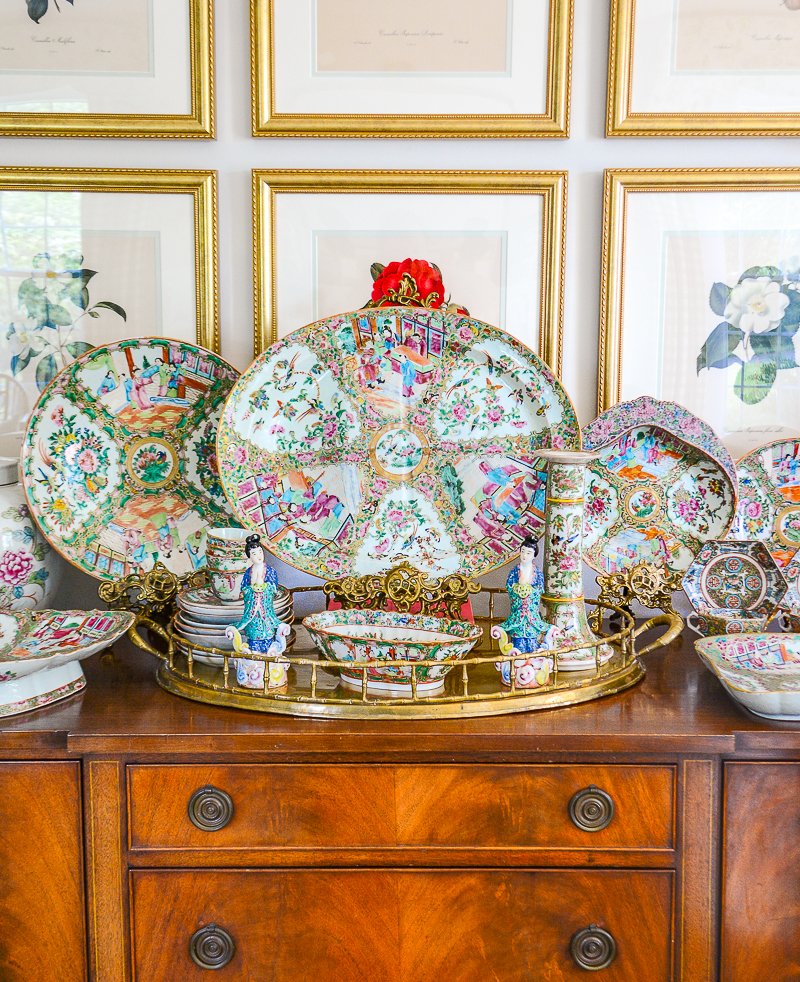
I have a collector's passion for Rose Medallion. I am always hunting interesting antique forms and hoping to land that sought after piece for a steal! Sharing my knowledge about this Chinese porcelain pattern always makes me happy, so let's delve into the 3 things you should know to start collecting.
First off just a little background in case you are unfamiliar with this antique. Rose Medallion is a style of porcelain or a pattern that developed about 1820. It was produced for the Chinese export market largely for European and American consumers. As part of the Famille Rose style, it uses overglaze low-fired enamel paints in pink, green, blue, aubergine, and yellow.
The pattern features a central medallion usually depicting a bird, tree peony, and/or rocks surrounded by four or more alternating panels showing people in one and then florals with fruits and birds in the next. The panels are called reserves and outlined by intricate borders of c-scrolls set agains green tendrils and pink florals. Bats, butterflies, and birds often decorate the outer edges of a form or fill in the spaces between the reserves.
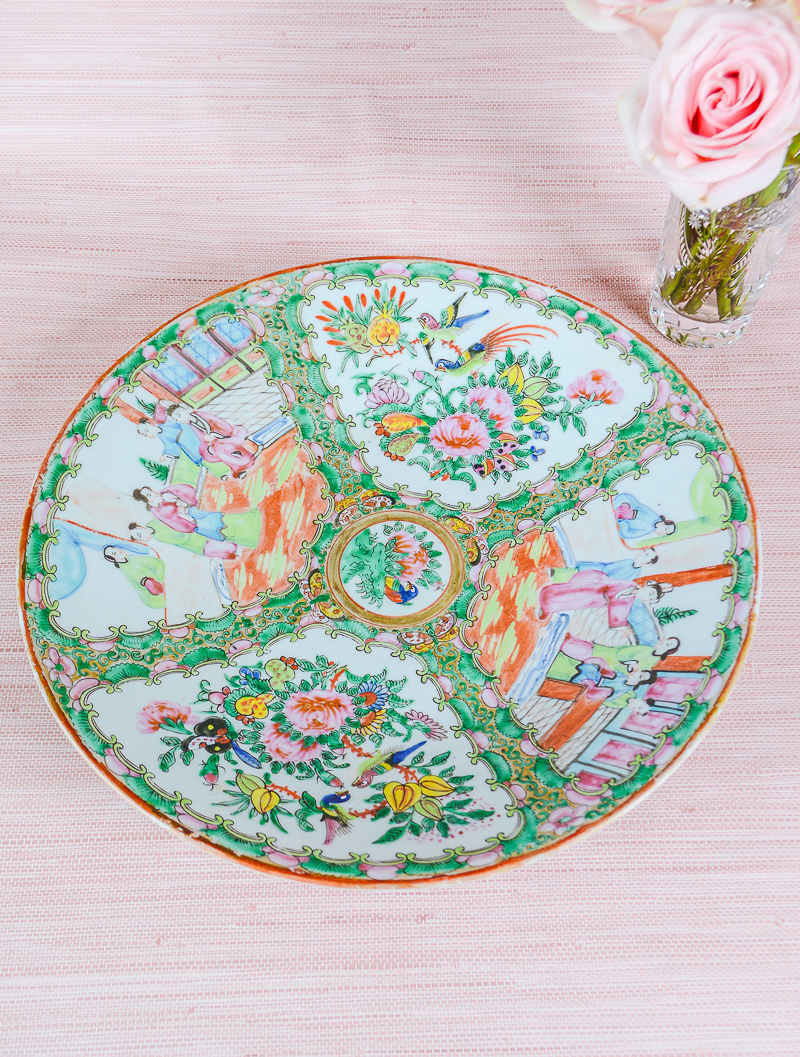
Note the 4 reserves on this late 19th century charger
Most experts agree that the pattern reached its artistic and technical peak by the mid-19th century although production continues today. The quality and delicacy of the pattern has devolved over the years, and with some careful study you can detect this decline and clearly see the loss of intricacy and detail. This change is very helpful when dating a piece of Rose Medallion.
For more on how to date and determine the value of Rose Medallion order my Guide for Dating & Valuing Rose Medallion!
But don't expect to establish an exact date for a particular porcelain unless it has an established provenance. Ranges of dates, for example mid to late 19th century, are acceptable, and be wary of dealers who claim that a piece was from 1834 unless they can provide a well traced provenance back to a particular export order.
No. 1 The Decline of Detail
As I mentioned above, the quality and delicacy of Rose Medallion has changed and evolved over the years. Most collectors and scholars agree that the pattern actually declined in terms of intricacy and detailed depictions of the figures and fauna from 1860 onward.
The most valuable Rose Medallion porcelains are early productions from about 1820 to 1870. These pieces have the most refined, artistically rendered designs, intricacy, and detail. The colors are also more vivid with a luminous quality that shows depth and gradation. They are clearly hand painted unlike many 21st century productions, which use stencils.
What to look for in an antique early to mid-19th century piece:
- Defined facial details with discernible expressions
- Painted gilt details in figures' hair and on the clothing
- Finely rendered birds with long tails and individual feathers
- Detailed backgrounds with defined architecture or landscapes
- Tight and more intense designs between the reserves
- Gradation in color to suggest shading and form
Examine the two photo details below! The first shows a reserve from a large meat platter probably made between 1830 - 1860. Note the gilt detailing as well as the carefully depicted clothing, birds, and butterflies. Now look at the next detail from 1950-1980. See how cartoonish the figures and birds appear? It is a much looser style with minimal details, and in between the reserves the designs are not densely packed.
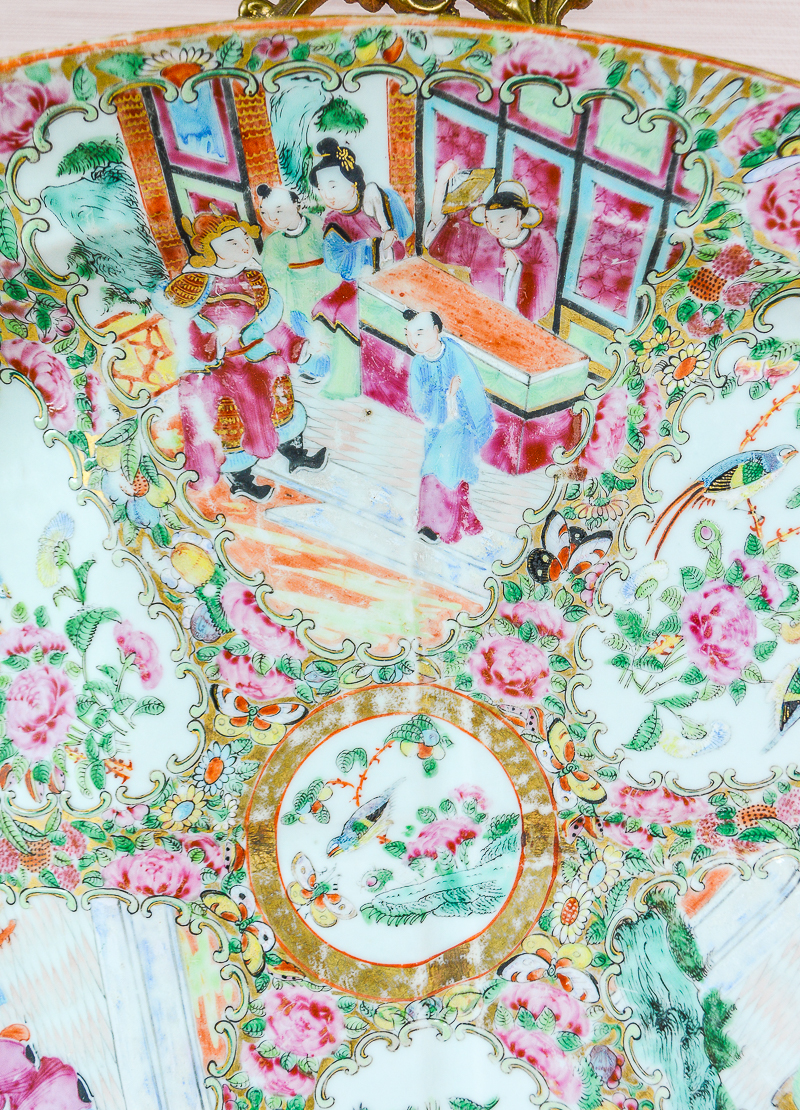

You can see more side by side comparisons of how the pattern changed over time in my post Rose Medallion 101: Building a Collection
No. 2 Previously Loved
Antique Rose Medallion services for the table were used! Flatware scraped over the plates leaving behind scratches and wear to the enamels. Some of these pieces could be 200 years old. It is normal to see some wear and tear: hairline cracks, old repairs, and flake like losses to the enameling.
Because these porcelains were decorated with overglaze enamels, they do not have a top glaze to protect them. You will see loss to these designs like in the above platter. As you clean and display your porcelains be careful to avoid scraping these delicate details off. Use soft cloths for cleaning and NO abrasive chemical cleaners. Stick with gentle soap or white cleaning vinegar and warm water.
It is important to bear in mind that these porcelains are not food safe to our modern standards. Most of the enamels were made with lead. Additionally, many of the vintage and modern productions are marked “Not for Food.” I do not use Rose Medallion dishes for serving and eating, but I do use teacups, teapots, and bowls with undecorated wells.
So how do I display it? Read this!
No. 3 What's in a Mark?
For the most part, Rose Medallion porcelains were not marked until 1891 when the U.S. required a "CHINA" mark be applied to import pieces. After 1919, that required mark was changed to "Made in China." This was usually done in red.

Made in China mark
It is important to understand that marks or lack there of are not in and of themselves the determining factor to a piece’s age or quality. Marks were sometimes sanded off of later pieces or altered. An early 20th century piece not intended for the American market might not have the “CHINA” or “Made in China” designation.
Dynasty or Imperial marks were often applied to later porcelains to dedicate the ceramic as homage to an earlier emperor. Many mid 20th century and 21st century vintage pieces have these apocryphal seal marks.
Marks alone cannot be used to date a porcelain with accuracy, and these are just a few of the examples of dilemmas with marks and dating!
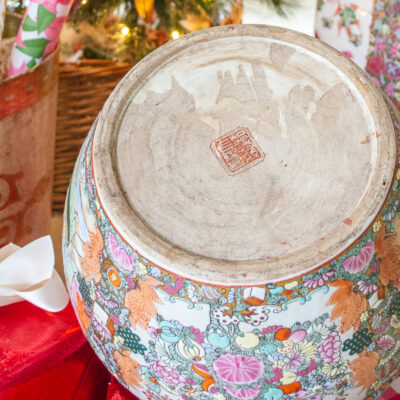
Apocryphal seal mark on a vintage late 20th century fishbowl
Learn more about collecting and authenticating Rose Medallion porcelain in my Guide to Dating & Valuing Rose Medallion
You can shop my latest collection of antique Rose Medallion porcelains here!
Pin this for later:
Fakes, Reproductions, & False Labels...
Everywhere!
So many antique malls don't even have antiques!
When hunting treasures how do you know what is authentic and not mislabeled?
You need to educate yourself ASAP, so you're not wasting money on knock-offs!
But how do you sift through all the millions of articles and books out there to get to the point?
Hi there! I'm Katherine...
the curator, writer in residence, and decorator behind Pender & Peony.
I’ve decorated my entire 1960s brick colonial with secondhand finds and antiques on a budget without sacrificing style, quality, or comfort.
You CAN have a traditional home with timeless charm on a budget too!
The problem isn't your taste -- it's an industry that glorifies the next big trend and only showcases high end custom design.
That's why I created The Collected Room Method to teach you my approach to the collected interior!
Beautiful vases & plates etc. I am doing a funeral for a collector of these beautiful vases and
wondering if the pictures on them tell a story. Thank you.
Hi! Not usually they are just scenes of court or domestic life. Sometimes the Mandarin pieces depict a battle, but those are very rare.
Are YT rose medallion dishes made in Japan and painted in Hung Kong safe to eat off of? I believe they were made in the 1970s. There’s a large set available for purchase, but I would like to use them for food.
No! These usually contain the most lead! I would not eat off of them.
So how would I go about selling my rose medallion plate?
Well…It just depends on what you have in terms of age and quality. You can do eBay, Etsy, a local antique or consignment store, an online retailer like me…If you want me to take a look at what you have book a personal assessment.
Thanks. I sent you a pic by email Btw, there are no markings on the back.
Katherine, I have an antique chinese rose medallion umbrella stand with markings on the bottom in chinese. Would you be willing to help me sell it?
Hi Tom! You can send me an email with photo at katherine@penderandpeony.com
I am so very happy to read all the wonderful and valuable info you have posted on this topic. I have looked on Ebay and Amazon and not found any books that specifically discuss Rose Medallion. You have helped me understand my interest in this topic. Maybe you should publish a larger volume on the 3 types of this ware. Thank you for what you have provided. I own about 20 pieces and have found that I have a “good eye” for the earlier ones and the wonderful shapes that they come in. I try to buy unusual shapes and sizes and always look for the best condition . I have been frugal and now see that I have gotten some great things at amazingly good prices. Yay for me!
That’s great Tony! There are a number of books about Rose Medallion – mostly published in the 80s. Take a look at my larger post about collecting RM and you’ll see I linked several.
Hi Katherine, I stumbled onto your site Googling Rose Medallion. I have learned a lot from you, or your expert opinion has confirmed what I thought may be true. I first fell in love with Rose Medallion when I lived in Charleston, SC in the mid-1980’s. The pieces I acquired while in Charleston provided the nucleus of my collection. I purchase with an eye for quality, i.e. details like vivid colors, gilding, gold hair ornaments in the hair of the court ladies. I find that a lot of earlier pieces have sand on the back acquired during firing. I occasionally find a jewel kind to my budget. The odd nick if the piece is otherwise desirable is not a deterant. I look forward to learning more from you. Maybe you should do a book on Rose Medallion. Richard
Thanks so much Richard! Sounds like you’ve curated a great collection. Yes, I am of the same mind — a little wear or slight chips add to the character and show history. Gosh – a book! I have so much more to learn, but maybe some day.
Hi! I have a dish or serving platter with these designs I don’t know anything about. Can you help me identify it? Thanks
Hi Peggy! You can email me a photo and I will have a quick look. Or if you want detailed information about it with a valuation you can book a personal assessment for $25.
I have a decent amount of Rose Medallion from my grandmother. I have a platter, cups and saucers, salt &pepper shakers, teapot, soup tureen, candlesticks, etc. what is the best way to determine their value and potentially sell them?
Hi Sharon, that’s wonderful. As you can tell we love Rose Medallion around here. You can book a personal assessment with me and I will value and date your collection. I also offer consignment, if you would like to consider selling the collection through me.