Federal Era Food & Finery
A look at the “delicate” dinner table. Bring your best manners and learn how our founding fathers dined in high style at the start of the nation!
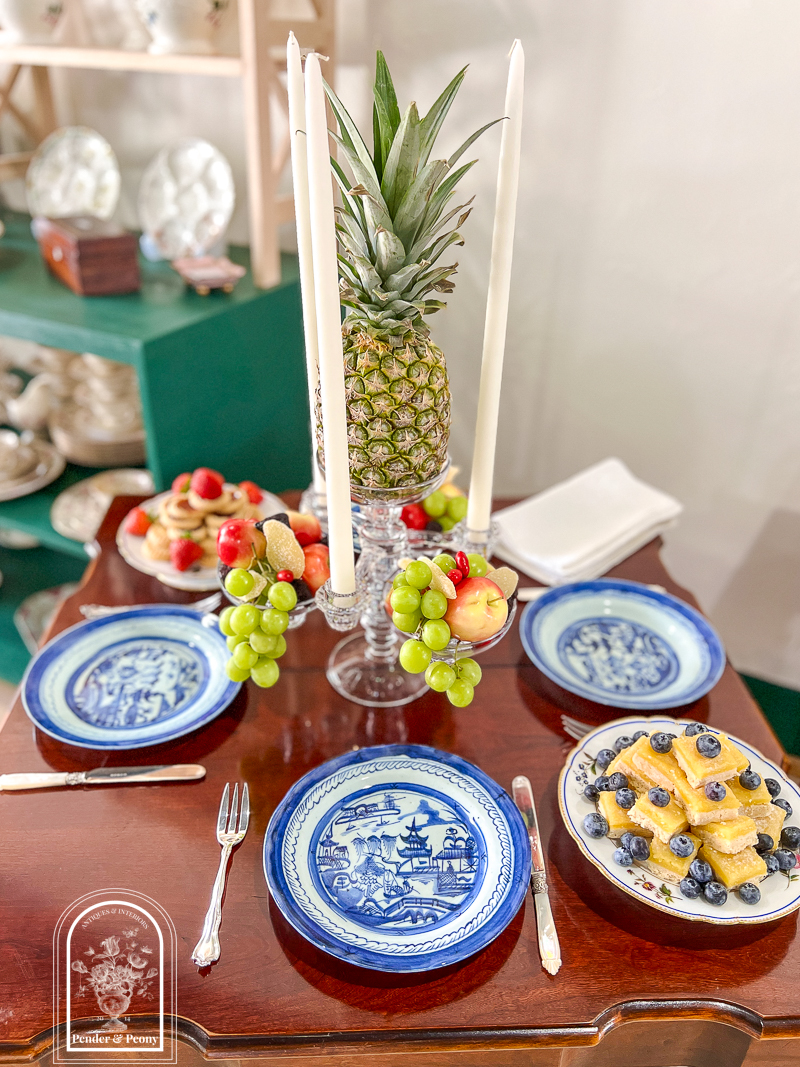
Tablescape inspired by the Federal era dessert tables for the Clinch River Antiques Festival
In relating all I know of America, I surely must not omit so important a feature as the cooking. There are sundry anomalies in the mode of serving even a first rate table; but as these are altogether matters of custom, they by no means indicate either indifference or neglect in this important business; and whether castors are placed on the table or on the sideboard; whether soup, fish, patties, and salad be eaten in orthodox order or not, signifies but little. I am hardly capable, I fear, of giving a very erudite critique on the subject; general observations therefore must suffice. The ordinary mode of living is abundant, but not delicate.
These observations on American customs and society are courtesy Mrs. Frances Trollope (1779-1863) who briefly lived in Cincinnati, Ohio from 1827-1831. She was an Englishwoman, writer, and mother of Anthony Trollope — yes that Anthony Trollope.
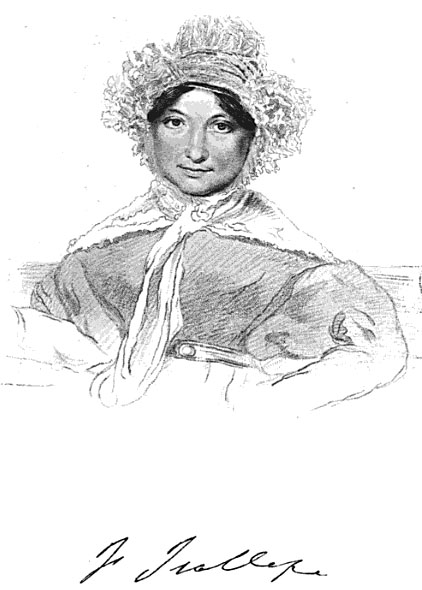
Mrs. Frances Trollope. Image via UVA
The importance of a civilized dinner
From this quote we get a sense of how important dining and dining with delicacy or refinement was to society in the early 1800s. Right? She calls it “this important business” and while Mrs. Trollope goes on to severely critique her hosts in the U.S. in her travelogue Domestic Manners of the Americans, saying there is a “total want of all the usual courtesies of the table,” she points out that their oddities and variances are not due to indifference or neglect. She recognizes dinner’s significance within American society although it certainly does not live up to her English standards.
As historian Myrna Kaye put it, “Display at dinner was a sign of civilization.” Federal era Americans with wealth and power expected bounty in the dining room and a high level of presentation even if it did not live up to some of their English contemporaries expectations. Despite American’s rhetoric of the time that renounced the excess and corruption of English society and the advocation of American distinctness, there was a strong preoccupation with proving American society’s sophistication and cultural validity through emulating familiar European social customs. Even Thomas Jefferson who while president ushered in new informality in hosting intimate dinners at the White House observed much of the ritual we will discuss.
In the 18th century the dining room itself was a new space within the American home. It’s really not until the mid to late 18th century that rooms solely devoted to eating dinner and entertaining dinner guests became common. During this time the table became larger and more permanently fixed in the center of the room and not able to be folded up and pushed against a wall when not in use. The sideboard grew and becomes a more complicated fixture of the room with cabinets and drawers for organization and storage for the equipage of dining.
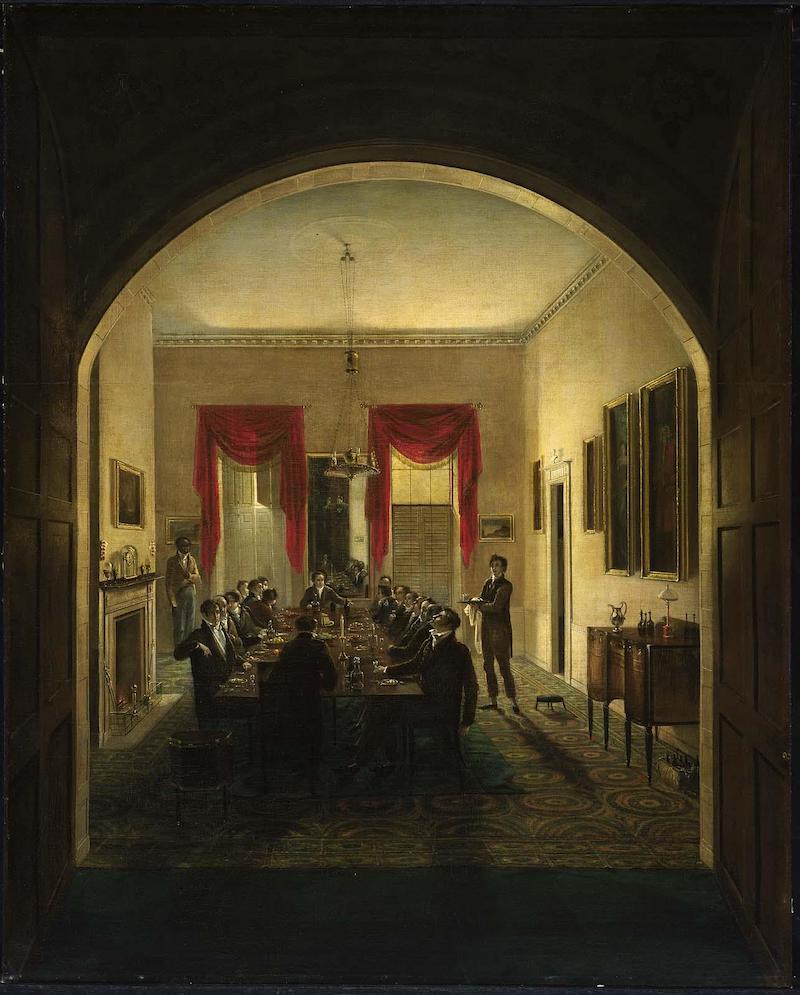
The Dinner Party by Henry Sargent, 1821. Image via MFA Boston
So what exactly did a first rate table look like?
We know from Mrs. Trollope’s account and many others that there was great regional variety in how dinner was presented and served. But “delicate” tables did exist, if we look at accounts from Mount Vernon, Monticello, the White House, and historic homes and plantations we can garner a good idea of how wealthy Americans of refined taste were serving dinner.
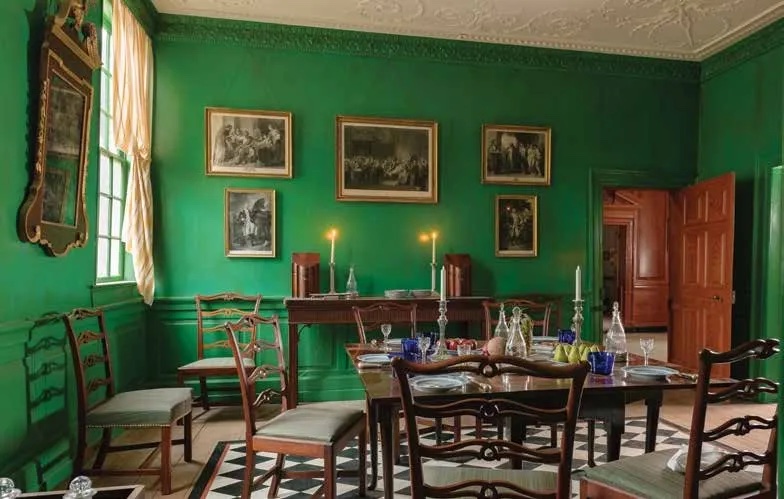
Mount Vernon Dining Room. Image via Mount Vernon Collections
First of all, dinner was served in the mid-to-late afternoon often at about 3PM. It lasted several hours and usually consisted of 2 – 3 courses with each course containing as many as 25 dishes for a large feast. The first course usually consisted of fish, soup, meats, and vegetables.
As Joshua Brooks (1773 – 1859 of MA, Brooks Farm, Battle of Lexington & Concord?) recorded in 1799 after a dinner at Mount Vernon:
The table was arranged with a leg of boiled pork at the head, a goose at the foot, and the following dishes arranged around the table: roast beef, round cold boiled beef, mutton chops, hominy, cabbage, potatoes, pickles, fried tripe, and onions. Beverages offered during dinner included wine, porter, and beer.
The tablecloth was wiped off before the second course, which included mince pies, tarts, and cheese.
The cloth was then removed altogether and port and madeira, as well as two kinds of nuts, apples, and raisins were set out. The eight diners were attended by three servants.
The table arrangement
The food would have been laid out symmetrically on the table usually in advance of the guests sitting down, so they could view the bounty and what was on offer. It was important that each dish of food was balanced with a similarly sized dish on the opposite side of the table.
Dinner was not served like in Downtown Abbey when the servant brings each dish around the table to the guests nor was it what we think of today as family style where the dishes are passed around in a circle. Guests would have served themselves and helped each other to the available foods within reach. The host and hostess would have carved the whole birds or calf’s head brought to the table.
The 18th century mode of dining is called Table à la Française – meaning in the French style.
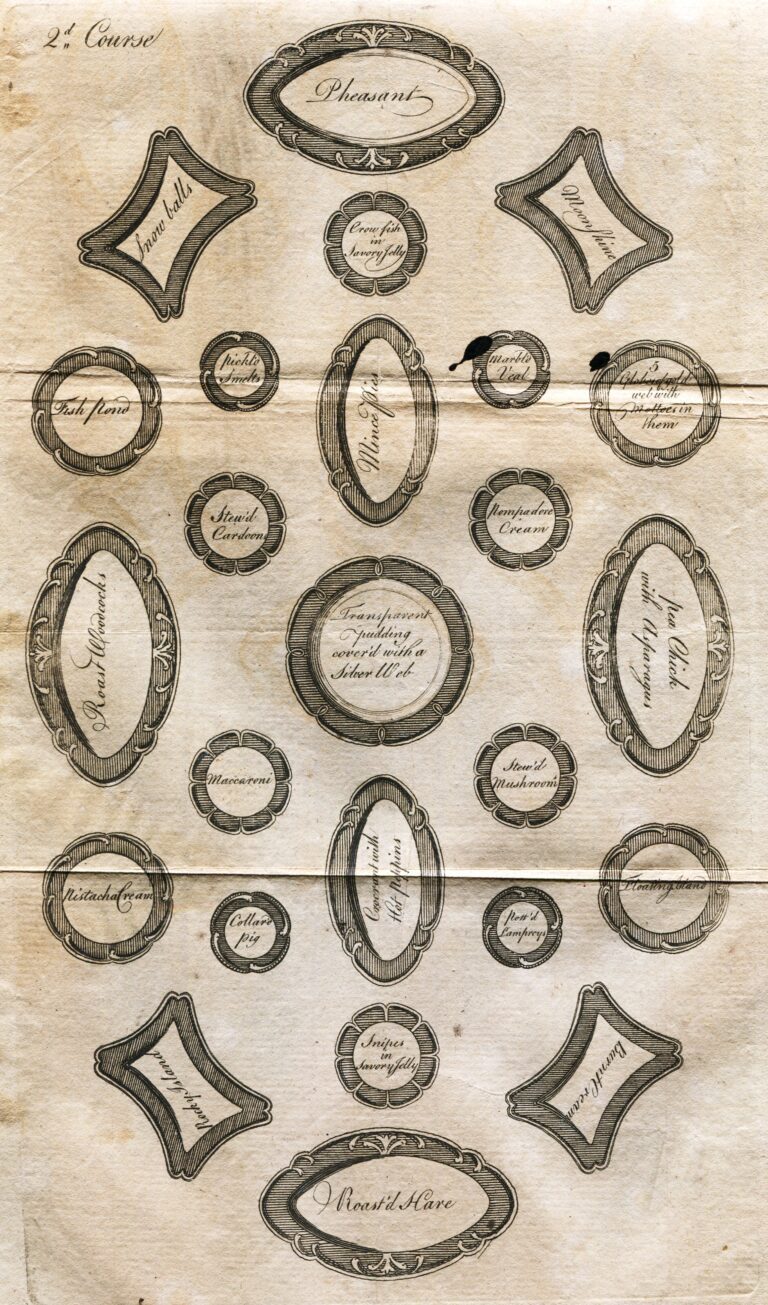
Directions for a Grand Table, 2nd Course by Elizabeth Raffald, The Experienced English Housekeeper (Manchester: Printed by J. Harrop, 1769)
The food of a ‘delicate’ table
While we would have recognized many of the foods on offer our taste buds might not appreciate them. Foods were served on the sweeter side with popular spices including cinnamon and nutmeg even in meat dishes. There were a lot of combinations we would have found strange like fruits with boiled meats. Jellies, organ meats, and dishes presented in the animal carcass would probably be least appealing to our modern sensibilities. For more on 18th century American foods, read this.
It’s important to keep in mind that the preparation of this food was highly labor intensive and very skilled for the most part working over an open fireplace. Many hands would have worked to produce such elaborate dinners and hours upon hours of labor. Cooks likely worked a 15 hour days 7 days a week. On plantations this labor would have been preformed by enslaved men, women, and children. The labor of the kitchen was separated from the dining room, especially as the Georgian house gets bigger the heat, smell, and hard work moves farther away. For more on the life of enslaved cooks, see this.
In many houses the second course would have been a largely sweet course then followed by an additional dessert course, which would have been mainly fruit centered. The dessert course was of particular importance in the 18th century and its extravagance and presentation reflected on the hostess. An elaborate dessert would have included a variety of sweetmeats — the term used to refer to jellies, candied fruits and nuts, marzipan, and other sugared treats.
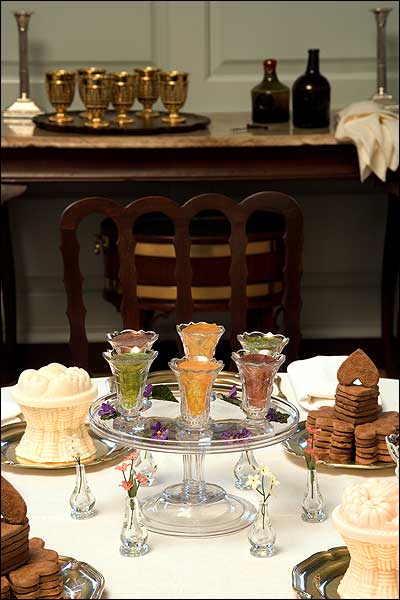
Table set with dessert pyramids. Image via Colonial Williamsburg
On ‘delicate’ table decor
Stacks of glass salvers, fruit pyramids, and by the mid 18th century epergnes would have been used to serve the desserts in a formal presentation that often served as the table decoration. The table would have been laid with a fine white linen or damask cloth, small placemats, or napkins for the first two courses then the linen was usually removed for the dessert course. Dessert was served on a bare table — better to show off the luxurious imported mahogany board — of course!
Other table decoration might have included sugar, porcelain, gilt ormolu, or silver figurines arranged on a mirrored plateau or surtout de table. Like the very grand one President Monroe ordered for the White House in 1817. To delight the Federalist spirit most of the figures would have been mythological or historical figures from the Greek or Roman pantheon.
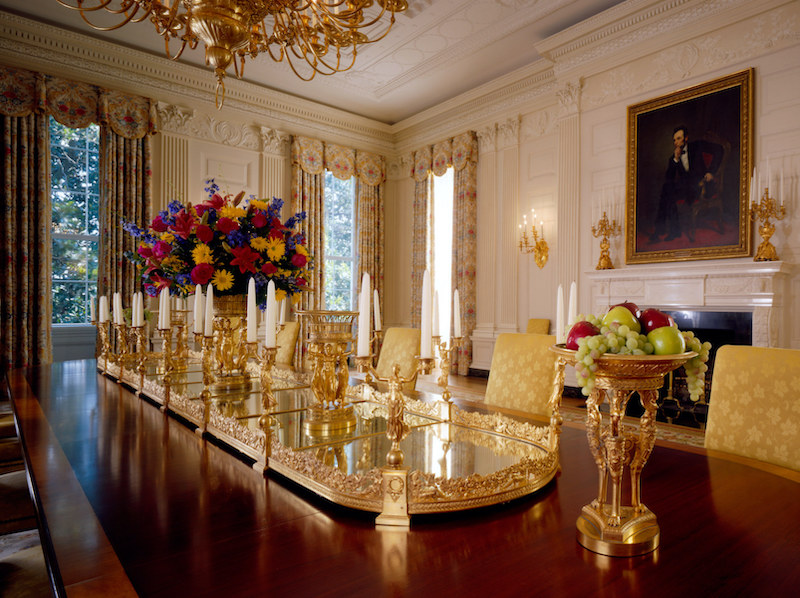
Monore’s surtout de table at White House. Image via White House History
Candles were added as the afternoon waned into evening and more light was needed. A castor or cruet set or soup tureen might have held center stage on the table before dessert. Not flowers. Elaborate floral centerpieces are more a mid-19th century style as dinner service changed to à la Russe. Large floral displays on the table were thought to interfere with aroma of decadent foods.
Cookbooks and homemaking guides of the period expended numerous pages on how the dining room should be set up and the table laid. In Mary Randolph’s The Virginia House-wife (1824) she wrote, “a dinner justly calculated for the company, and consisting for the greater part of small articles, correctly prepared, and neatly served up, will make a much more pleasing appearance to the sight give a far greater gratification to the appetite….”
The ceramics of a ‘delicate’ table
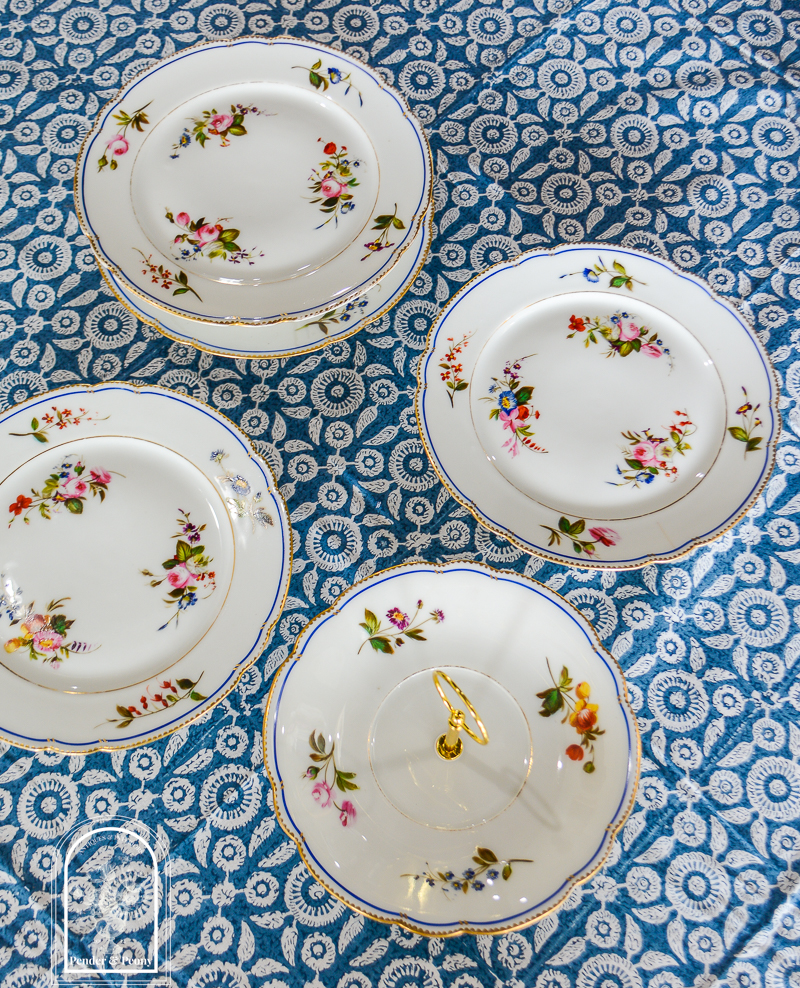
French Porcelain Dessert Compotiers & Server, Probably part of a dessert service and possibly Bernardaud’s A La Reine pattern. Available in P&P shop
The importance of the dessert course can also be appreciated by the flourishing of ceramic dessert services. These sets became very large during this period – some having as many as 500 pieces and including specialty silverware. The decoration of each piece become more elaborate and colorful. Important sought after makers of these services included Meissen, Sèvres, Derby, and Bow as well as custom Chinese export porcelains. A full service included compotiers, glacieres, coolers, jelly glasses, and more.
For example: the dessert service of Pennsylvania’s Governor Mifflin in the 1790s covered 3 large tables and supplied 24 guests with 3 plates each and included 12 fruit baskets and stands.
There would have been an array of ceramics on the American table during the Federal era. Of course the finest houses were using custom ordered Chinese, French, or English porcelains for entertaining, while upwardly mobile middle and working class people would have used “common India china…” or perhaps “earthenware” probably cream glazed. While “Chelsea porcelain and fine India China being only for the wealthy. Pewter and delft ware could be had but were inferior.” So notes, Charlotte Louise Henriette Papendiek (née Albert; 1765–1840) – a German-born lady-in-waiting to Queen Charlotte of Great Britain and a noted memoirist of the British court during the reign of King George III. It’s not too far a stretch to say this would have been true of the American dining table as well.
What does she mean by “common India china”?
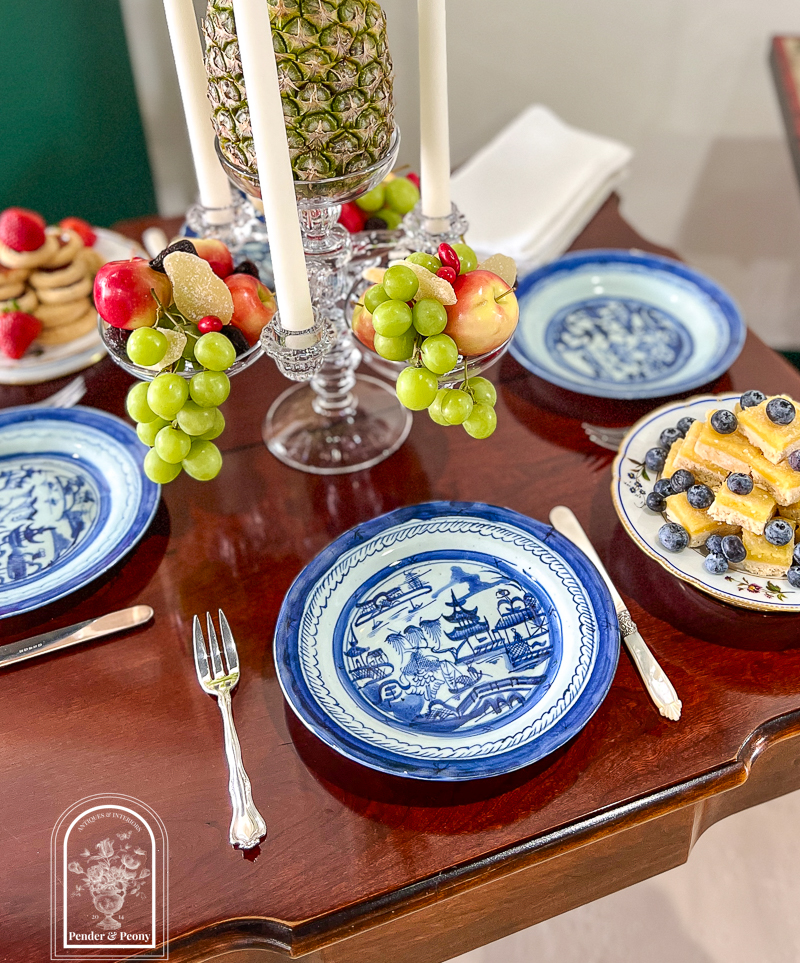
Before the American Revolution Chinese porcelains would have been imported through England via the East India Company along with other Chinese goods like tea and silk. This is part of the contention with England and the taxation on these luxury goods helps spur the American Revolution.
Americans wanted to establish direct trade with China and were finally able to do so in 1784-5 with the ship – the Empress of China, which traded ginseng, fur, and pig lead for the coveted Chinese goods. In fact, the Chinese trade was so lucrative that several of the first American millionaires—John Jacob Astor of New York and Stephen Girard of Philadelphia made their fortunes in the China trade.
It was truly all the rage to have “China” plates on the table whether they were custom ordered with monograms, heraldic devices, symbols of the new nation like the eagle or ready made patterns like blue Canton. Between 1784 and 1846 as many as 40 US ships a year voyaged to China for trade. The largest shipment of porcelain on record carried 5,800 piculs of porcelain. One picul “pikle” equates to about 130 pounds, so if we do the math that’s about 750,000 pounds of porcelain. If you figure a dinner plate might weigh 6-8 ounces or so…that’s a lot of dishes!
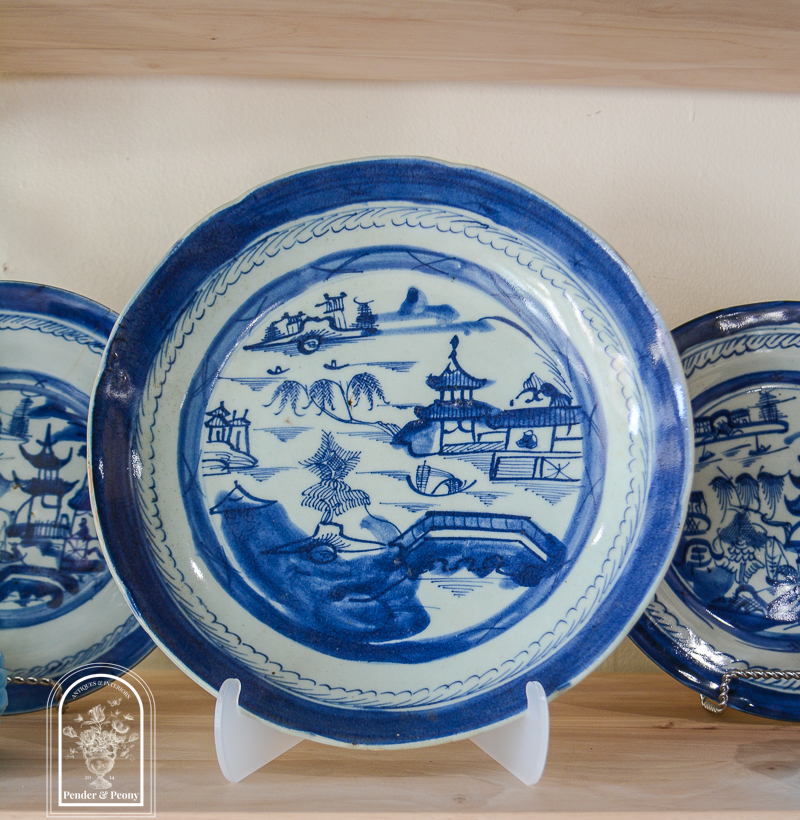
Blue Canton
One of the most popular patterns of porcelain was what we call Blue Canton, so named for the city Canton (Guangzhou) from which it was exported. It was a ready-made pattern, meaning the dishware was pre-made to sell to the West, and it usually served as ballast on the cargo ships, being loaded in first before the made to order dishes and the more precious commodities of tea and silk. This then is what Mrs. Papendiek means by “common India china.”
You may recognize it as the pattern that George Washington had and used at Mount Vernon. Which is true, but it was his “casual” china or just for family use not for high entertaining.
Blue Canton was then often sold directly from the ship once it reached American ports. By the early 1800s a 50-piece Canton tea service cost about $3, equivalent to about $40 today. For comparison, a custom order set cost about $150-200. Over the next decade or so the Canton pattern became the porcelain of choice for the middle class.
By 1805 merchants referred to this pattern as “blue & white of a landscape Pattern & of a good but common kind,” and by the mid-19 century one merchant reported that it had been “exported in the millions of sets.” For more read this.
This version of blue and white porcelain features underglaze blue decoration, a rain and cloud border, large pagoda on right, and bridge in the foreground. The rain and cloud border indicates it was produced earlier in the period than pieces with just a straight line border. The design drew from Chinese landscape paintings in which hills and streams were the key elements. In Chinese landscape painting, the flow of the lines to convey ch’i is critical as is the attempt to convey harmony of nature and the artist’s experience rather than a straightforward, realistic portrayal of a scene.
To the Western eye the simplified forms, unusual perspectives, and reduced colors appeared exotic and naive. Without a doubt blue Canton fed Westerner’s fantasies about China and fascination with the exotic East. Which was largely cloaked in mystery as the Chinese Emperor would not allow Westerners outside the trading Hongs in Canton. “Our first ideas of China-dom,” wrote one writer for the Boston Atlas in the in 1845, “were formed at meal times, and illustrated with plates.”
After a ‘delicate’ dinner
Men often remained in the dining room to drink of liquors, wine, and more often than not a specialty punch and smoke pipes, while the ladies retired to a parlor for tea and coffee. Of course the serving of tea and coffee had its own very special ritual and preparation. More on that here.
Dinner parties often continued on into the evening hours with dancing and a light supper being served.
I hope this post has given you some detailed insight into the high style dining habits of our early nation and the ways in which those customs and rituals influenced tableware and table decor.
Sources:
“At Table: High Style in the 18th Century” by Sarah Nichols
“A History of Chinese Export Porcelain in Ten Objects” by Ronald W. Fuchs II
China for America: Export Porcelain of the 18th and 19th Centuries by Peter Herbert and Nancy Schiffer
“Dessert Pyramids: A Feast for the Eyes and the Palate” by Mary Miley Theobald
“Dining in America late 1820s – from the British point of view” by Patricia Biller Reber
“Dining at Mount Vernon” by Mary V. Thompson
“No 70 – Domestic Manners of the Americans by Frances Trollope (1832)” by Robert McCrum
“Elizabeth Raffald: When Service à la Française Met Service à la Russe” by Stephen Schmidt
“Imagined Journeys to Distant Cathay” by JR Haddad
“New Perspectives on Chinese Export Blue-and-White Canton Porcelain” by Leslie Warwick and Peter Warwick
“Salem Sets Sail” by Doug Stewart
There’s A Bed in The Piano by Myrna Kaye
“’To a Lady of any delicacy’: A visual exploration of the sway of English dining etiquette on early American identity” by Melissa Reynolds
wish you all the best
Thank you.