
Infuse Historic Charm into a Builder Grade Home
10 Tips to bring historic charm and character to a new build or builder grade home.
Let’s outdate that modern construction! Ban the sterile white box! Nix the cookie cutter uniformity!
Bring on the warmth, character, and charm of a period home with architectural features!
For most of us the reality of housing markets, location, and finances means we’ve settled for a newer or newly constructed house and not the period home we’ve always dreamed about. The cozy English cottage is across an ocean. The Georgian townhome is more than a pay raise or two away. And that Victorian farmhouse is out in the middle of nowhere with a 2 hour commute.
But that doesn’t mean you have to abandon all your visions of a Greek Revival, sprawling farmhouse, or quaint cottage. With some attention to detail, elbow grease, construction dust, and spunky resolve you can transform the white and gray, open concept, boring box!
Here are 10 tips to infuse historic charm into that builder grade home:
No. 1 Embrace Classical Design & the Traditional Interior
How many of you knew this would be number one? 🙋♀️ Heh…well at least I’m consistent. LOL
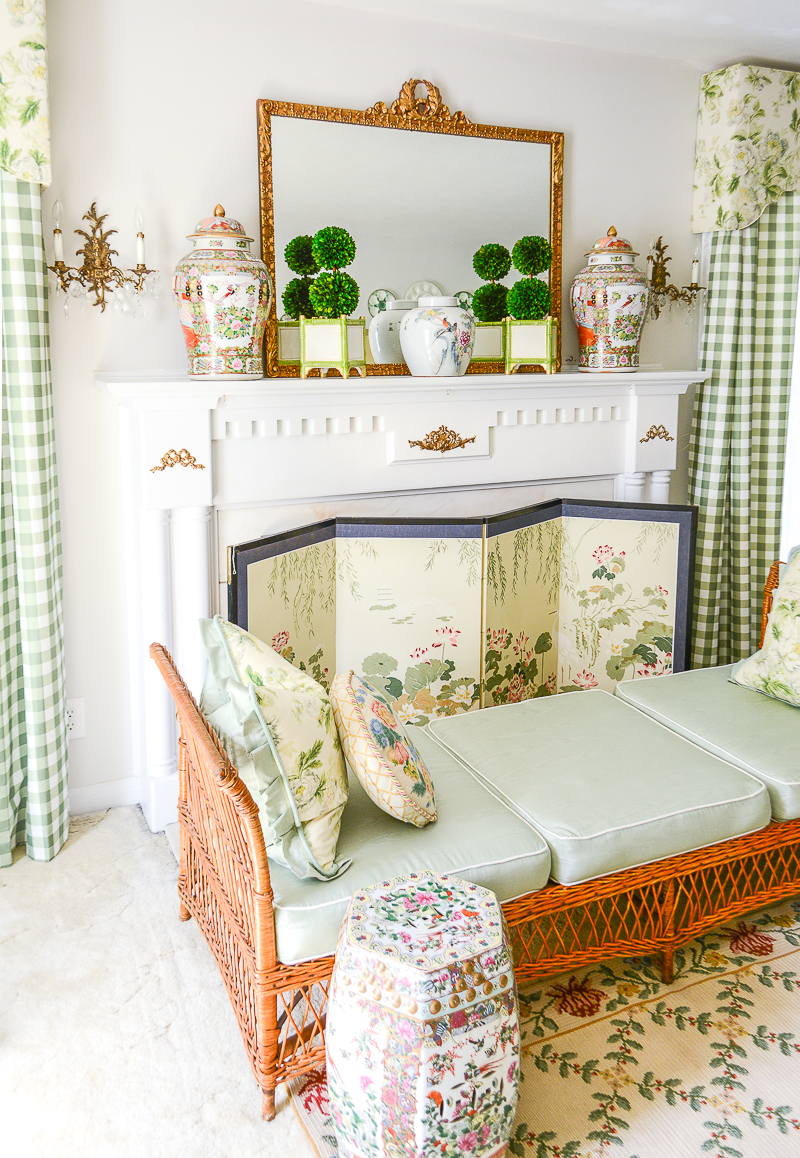
A layered interior following classical design tenets with a mix of antiques, patterns, art, and colors is essential to bringing historic character to new construction. Decorating your home this way is not a quick fix. It will take time to achieve that collected traditional interior, so here are 4 keys I would focus on:
- Mirrors – Where can you add stately antique mirrors to create a focal point, bounce light, and/or add visual interest?
- Go for symmetry! Buy in pairs and carefully balance furniture and accessories.
- Add large anchoring furniture to rooms like secretaries, bookcases, and armoires. Historically, built-in closets were few and far between. People depended on the storage capacity of furniture, so add these antique workhorses to areas that need a monumental piece.
- Proportion! Proportion! Proportion! I see this mistake in a lot of new homes with vaulted ceilings where the furniture is totally dwarfed by the room. If you opt for that two story living room, you have got to go bigger with everything: furniture, art, drapes, EVERYTHING!
For more traditional interior inspiration read this!
No. 2 Bring on the Woodwork
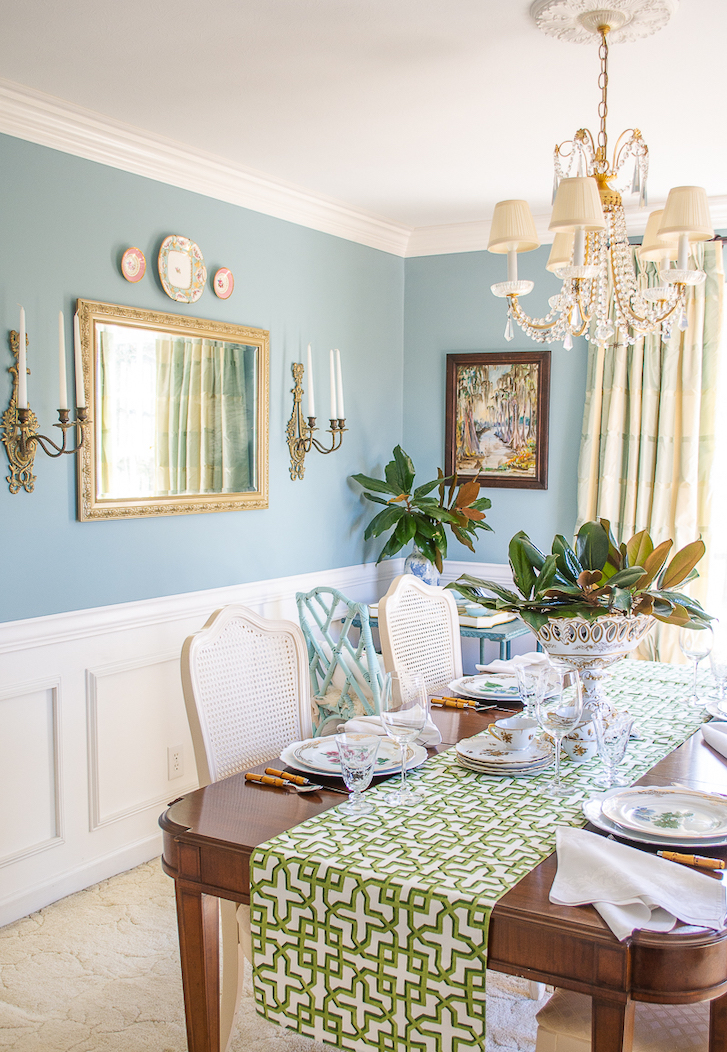
Paneling, wainscoting, crown molding, window and door casings, and baseboards are visually appealing. They add depth and dimension to a room. They instantly upgrade a plain wall. I’ve toured hundreds of historic homes, and I have never been in one that did not have some combination of those millworks.
Certainly, this can be an expensive addition to your home. But it will be so worth it. If you are handy with a saw and not afraid of a little math, try to do it yourself. I’ve got a tutorial for faux wainscoting here and crown molding here.
No. 3 Color is Character
If you’ve toured any historic home, I bet you’ve been confronted with more than a few color filled rooms. Even when white is used on the walls it is for a certain dramatic affect and not as a default color. Gray was often used for utilitarian spaces and servants’ areas. Read that again!
Ban the sterile white box!
On the opposite hand, don’t feel like you have to bring the entire rainbow into your home or revive the Victorian penchant for acidic color pairings. Pick a few colors that speak to you and infuse them throughout your house with furnishings, accessories, and yes – paint!

Drayton Hall Plantation in S.C. is total goals for elaborate mantels, plaster work, and mill work!
No. 4 Outdate Your Fireplace
The fireplace in a room almost always becomes a major focal point. Don’t let that go to waste. Use this to your advantage and add historical character by swapping out a boring or blocky mantel for something more graceful and crafted. You can buy antique/vintage mantels and fire surrounds at architectural salvage shops for decent prices under $500. It may take a bit of sanding, striping, and painting or staining, but the craftsmanship will be worth it!
Also nix the television above the fireplace. Please for the love of traditional interiors! Nix it!
No. 5 No More Boob Lights
If you know you know, and if you don’t…take a look at just about any new construction builder grade flush mount ceiling light. I can almost guarantee it will be a rounded bowl shape with a knop in the middle. Do you see it now?
Welcome to the club. You’ll never not unsee that comparison! Read this!
No. 6 Close Off or Zone the Open Space
Most of us swallowed the open concept floor plan pill whole heartedly in the 90’s and walls became totally noxious to us. Thankfully, this trend seems to be reaching its life span and we are re-valuing the benefits of rooms with walls and having closed off defined spaces for specific purposes. Just a few benefits that come to mind: better organization, privacy, noise reduction, and design variety.
If you live in an open concept house and can’t add any walls, try adding in partitions using folding screens (see this post) or tall pieces of furniture. It might be possible to hang a tapestry or create a portiere over an archway or open passage. The fabric will be a wonderful noise deadener too!
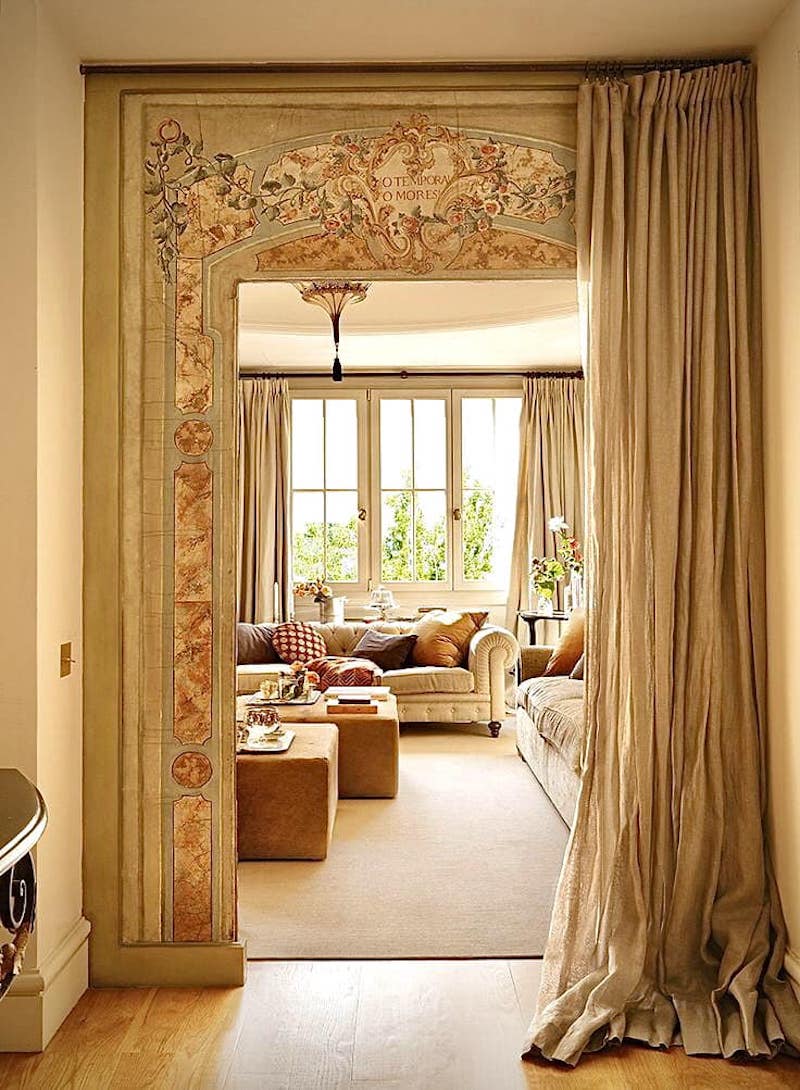
Example of a portiere. Image via Eye for Design
No. 7 Swap for Luxe Hardware
One big indicator of a builder grade house are the basic looking hardware and faucets. Upgrading your door knobs, cabinet pulls, hinges, and bathroom fixtures is a guaranteed way to combat the monotony of cookie cutter construction. Yes, this small detail will add more character and change the look and feel of your home and quite possibly improve functionality because you can upgrade quality as well as look.
No. 8 Layer Texture
Homogenized new construction and builder grade finishes often create a sterile ambience. A great way to combat this is by bringing in more texture, especially with natural finishes like stone, wood, wool, bamboo, and cotton. If everything is smooth and shiny, the space is more likely to feel sterile and cold.
If you are able to replace flooring or countertops, choose the natural option and think about how different surfaces can add interest to the look and feel of a space. Check out this new construction living room from designer Alexandra Eidenschenk. Note the varied natural textures: wood, jute, bamboo, brick. The textured and paneled walls. The beams. The beautiful casings! This space does not feel new or monotonous even with cream walls.
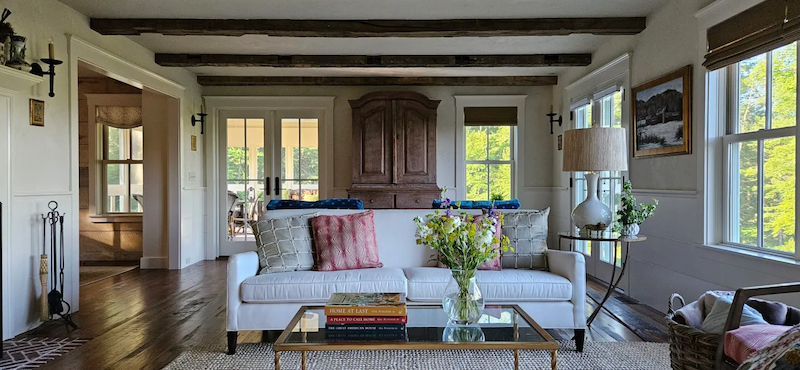
Design by Alexandra Eidenschenk
No. 9 Wallpaper: Just Do It
Historic homes have dressed walls, meaning there is some form of decorative treatment like a chair rail, paneling, lime wash, plaster, etc. A lot of people really fear wallpaper, and I totally get it after removing ugly patterns from our 1960’s colonial brick home. Wallpaper is a big expensive commitment. BUT…it is the best decorating game changer for a room. The right pattern will instantly add historic charm.
Take your time and really consider the right pattern. Order lots and lots of samples. Don’t depend on your computer monitor because the colors will likely appear different in person. And whatever you do, DON’T do an accent wall! My one exception to this is a paneled mural.
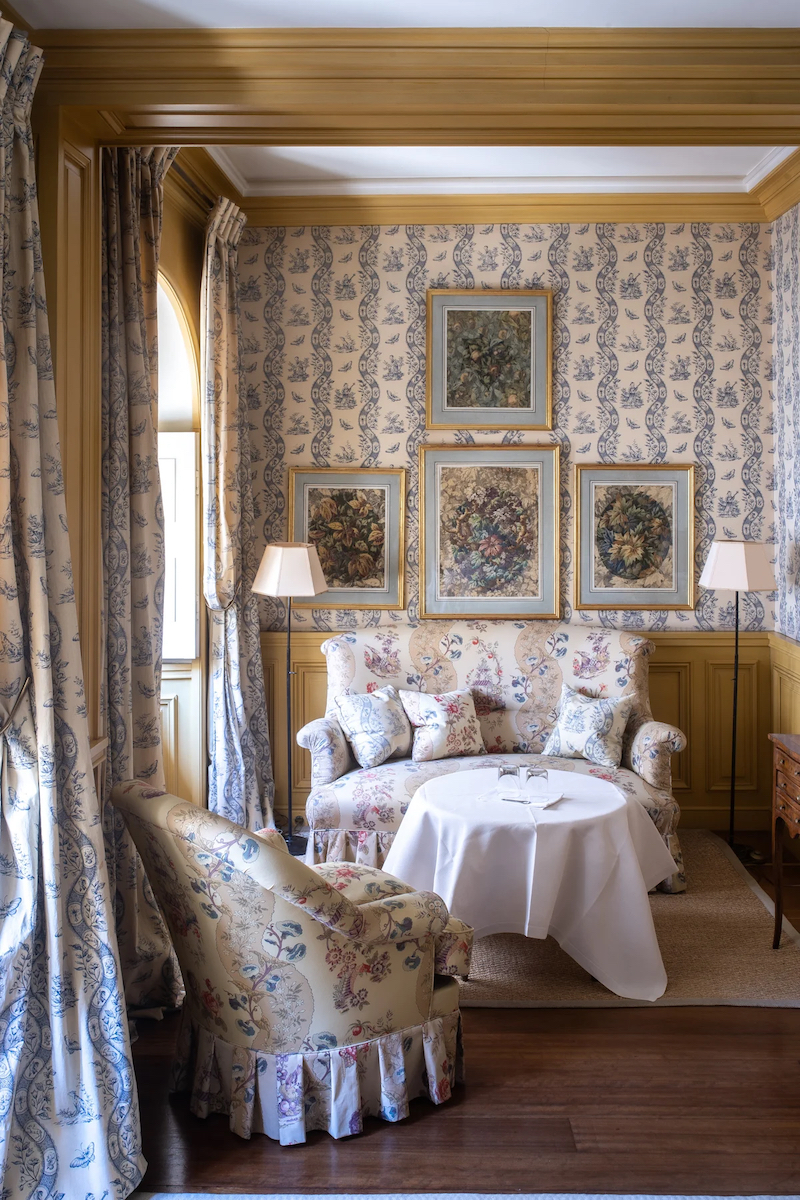
La Mirande, Image via Stacie Flinner
No. 10 Curtains Are the Solution
If you want to bring in that traditional look and feel of a period home to your new construction, curtains are always a good idea! Draping fabric will instantly make a space feel more cozy and warm. Curtains soften the look of your windows and provide a transition from the outside to the interior.
Don’t skimp when it comes to the width and length. Always go bigger than the actual dimensions of your window. I’ve got a helpful post on choosing bedroom curtains here.
Also curtains aren’t just for windows:
- Drape a bed for a dramatic focal point.
- Create a fabric door with a portiere.
- Hang them under a counter-top instead of cabinet doors.
Whew! We covered a lot of ground with these 10 tips to add historic character to your builder grade or new construction home. I hope I’ve inspired you to embrace the traditional, get your hands dirty, go bold, and add charm to your home!
Hi there! I'm Katherine...
the curator, writer in residence, and decorator behind Pender & Peony.
I’ve decorated my entire 1960s brick colonial with secondhand finds and antiques on a budget without sacrificing style, quality, or comfort.
You CAN have a traditional home with timeless charm on a budget too!
The problem isn't your taste -- it's an industry that glorifies the next big trend and only showcases high end custom design.
That's why I created The Collected Room Method to teach you my approach to the collected interior!