
3 Things You Should Know About Persian Rugs
Curio IQ Series: Let’s take a short and sweet lesson in antiques! Today, we are looking at the 3 things you should know before investing in a handmade Persian rug.
The exotic magic of Persian rugs has captured the imagination and attracted devotees for centuries, and what's not to love? The intricate patterning, the vibrant colors, the skilled techniques, and the luxurious materials all contribute to the beauty and allure of a handmade Persian rug!
Walk across one of these coveted rugs just once in your bare feet and I guarantee the sumptuous wool, cotton, and/or silk materials will convert you.
Their ubiquitous use in the traditional interior really needs no explanation, but this same popularity does not translate to an understanding or basic foundation in the techniques and characteristics that make a Persian rug a quality investment. In this post, we will delve into some rug basics that are essential to improve your shopping experience and make you a more informed buyer!
First, a clarification: You will often hear the terms Oriental and Persian used interchangeably. The conscientious among us use Oriental to refer to all rugs made in the East: China, India, the Middle East, and Turkey, etc., while Persian refers to rugs made in what was once Persia, more or less modern day Iran. Experts further identify rugs based on their specific geographic origin because the designs, type of knots, materials, and colors are indicative of that region.
In this post, we are specifically talking about those handmade rugs from the Middle East although many of the terms and processes are applicable to Oriental rugs as a whole.
No. 1 Design Anatomy of a Handmade Persian Rug
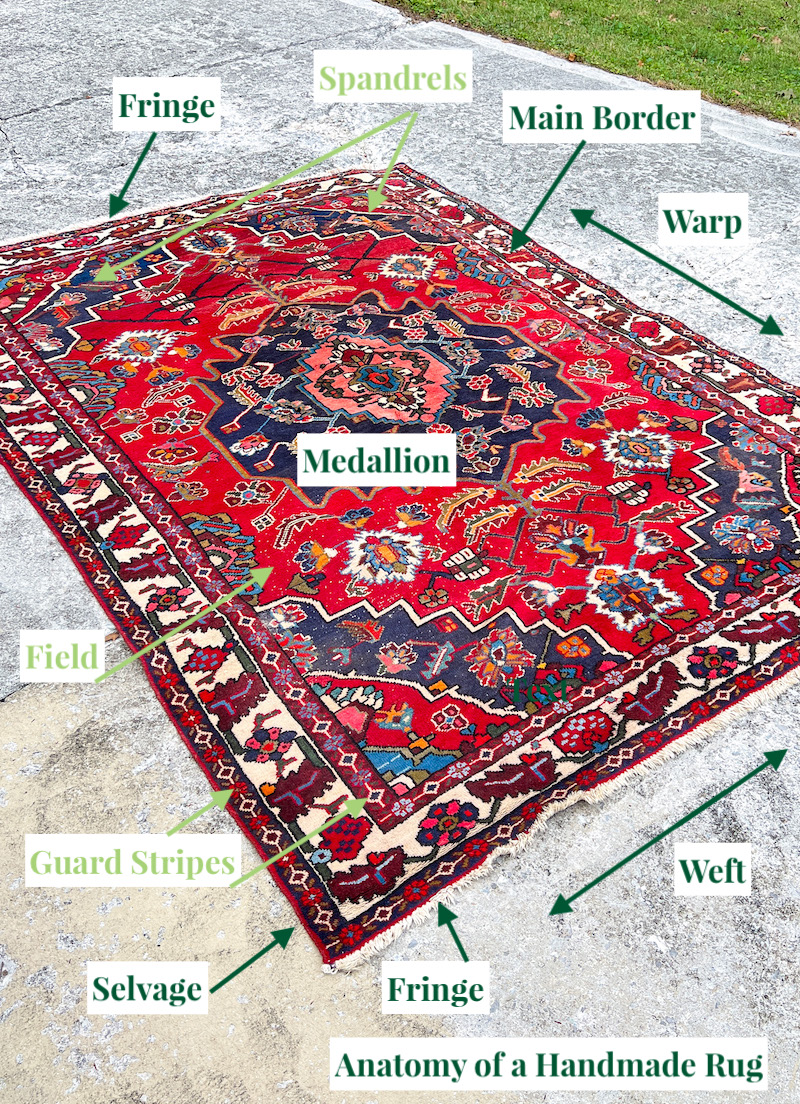
This is a handmade Heriz style rug, probably made in the late 20th century, that I purchased at auction last summer. I laid it out in the driveway before taking it for professional cleaning.
Fringe - End of the warp threads tied or finished in various ways to secure. These are an integral part of the handmade rug and not an added on tassel. Fringe is often the first part of a rug to wear down and show abuse.
Field - The interior of the rug design surrounded by the borders.
Guard Stripes - The frame of the overall design, probably more than one.
Main Border - The main design outside the field near edge and between guard stripes.
Medallion - Many Persian rugs have a central decorative element, characteristic of traditional, symmetrical Persian rug designs.
Selvage or Selvedge - The sides of the rug where warps are bound together or a thicker piece of yarn is sewn on to the edge to protect the knotting.
Spandrels - The decorated corners of the rug.
Warp - The vertical or north to south structural threads of the rug stretched on the loom and to which the knots are tied. The foundation of the rug often done in cotton.
Weft - The horizontal or east to west structural threads of the rug interwoven between the warp and knot threads. Visible on the back of the rug. Part of the foundation of the rug often done in cotton.
No. 2 How It's Made
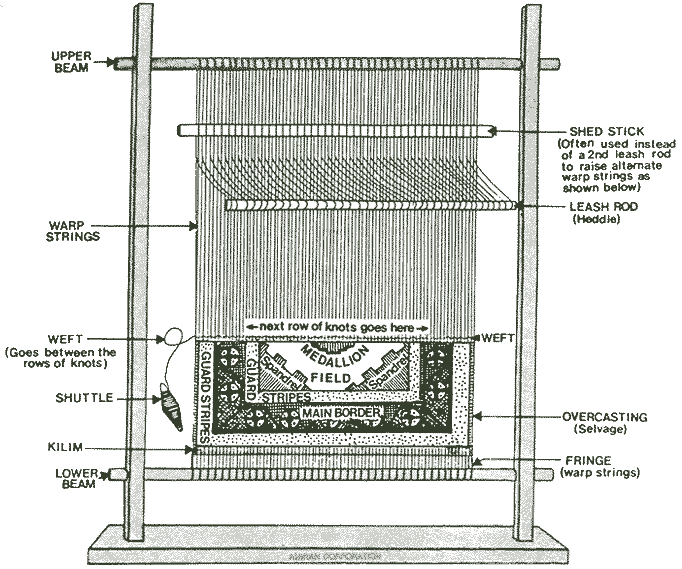
Handmade Persian rugs are hand knotted on a manual loom that can be vertical, standing upright, or horizontal, laid on floor (typically used by nomadic tribal weavers). The warp threads are stretched between the bars of the loom parallel to each other and then the weaver hand ties pieces of wool thread on to the warps leaving the ends loose to form the front pile of the rug.
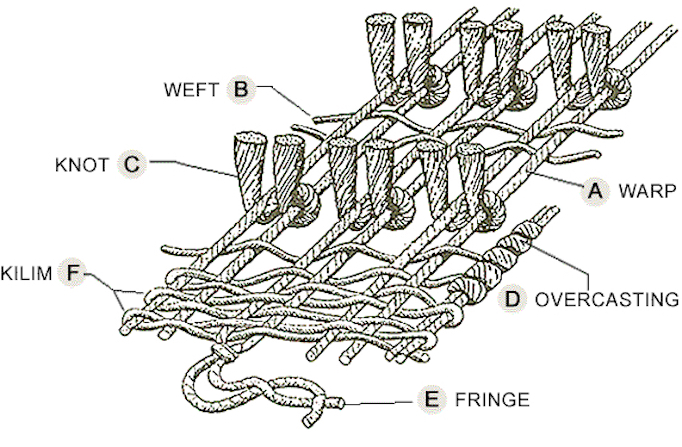
These short pieces of thread are called knots, but they are actually just looped around the warp threads. Then the horizontal weft threads are woven perpendicular to the warp threads between the rows of knots. These knots are typically tied in one of two ways: Persian style (seen in diagram), which is an asymmetrical knot or Turkish, which is a symmetrical knot.
Watch this video to better understand the loom and weaving process:
Because of the manual looming process each rug has a “direction” as the ends of each knot are pulled down while cutting the yarn. If you are standing at the top end, the rug will look markedly lighter than looking at it from the “bottom” end. You can also determine the direction of the pile by running your hand vertically (fringe edge to fringe edge) across the front of the rug, and it will feel like you are either ruffling the pile or smoothing it. This is important to know when it is time to vacuum and dust your rug. More on that coming soon!
No. 3 A Handmade Persian Rug is Imperfect
Part of the beauty and character of a Persian rug comes from the handmade process, which depends on the skills, knowledge, and special artistry of the weaver(s). The rug will NOT have the perfect symmetry, color uniformity, and sizing of a machine made rug. Thank goodness!
Instead it will be perfectly imperfect with slight variations in the pattern from side to side and top to bottom. The specific boteh (paisely like forms), guls (flower heads), and arabesques may show variations in sizing, placement, and proportion or differences in color. The rug will have a crisp, harmonized design.
You will also note changes in the shades of a specific color as your eye moves across the rug. This is called abrash, and it results from variations in color from one skein of wool to the next or the way a skein absorbed the dye from the exterior to the interior.
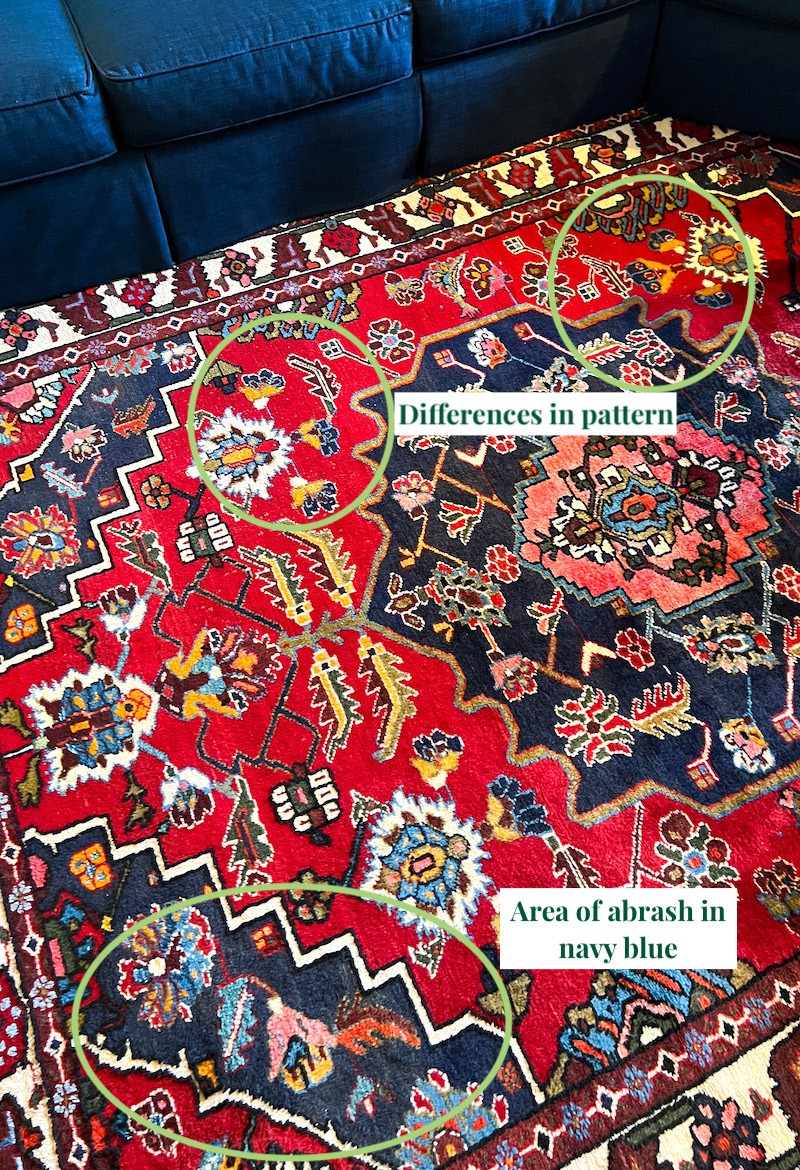
Here is my lovely Heriz rug freshly cleaned and now decorating our family room floor!
If the handmade rug is vintage you will also see two main features: some size distortion from being walked on and some white foundation knots (also called freckles). These foundation knots are simply where the weaver had to tie the weft threads together to continue the weaving or where two warp threads broke and were tied back together. Many weavers use un-dyed cotton for the foundation threads, so over time these knots can be seen through the pile. Sometimes these knots are dyed or inked to blend in with the colors of the rug, but overtime that coloring may lift off. See next photo...
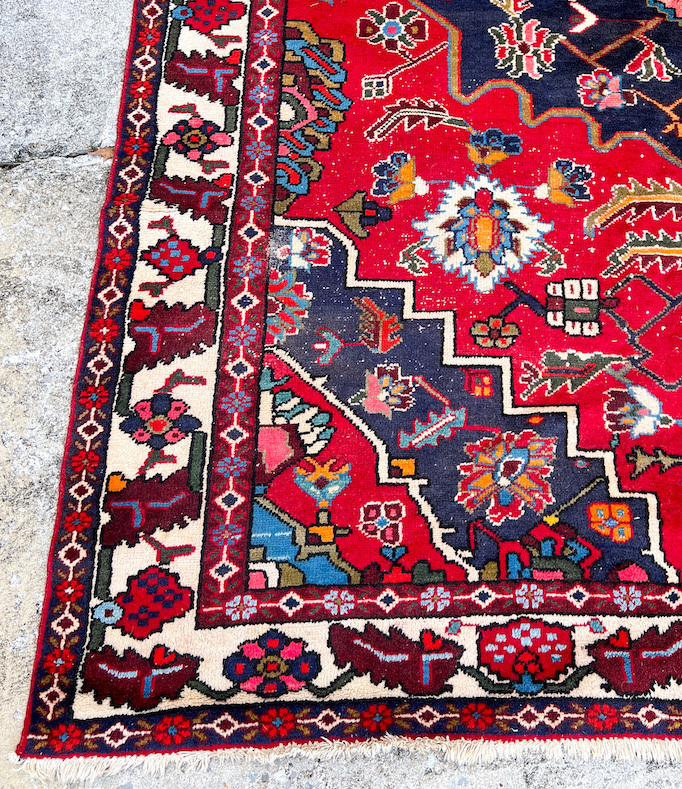
Want to learn more about how to identify a handmade Persian rug versus a machine made one? Get my e-book The Grandmillennial's Pocket Guide to Chic Antiques! There is a whole section on how to authenticate a handmade rug.
Watch this video to learn more:
Next week, I'll be sharing the professional cleaning process my rug went through and why it is so important to take care of your handmade rugs for longevity.
Need style advice on choosing the right rug? Read this post!
Fakes, Reproductions, & False Labels...
Everywhere!
So many antique malls don't even have antiques!
When hunting treasures how do you know what is authentic and not mislabeled?
You need to educate yourself ASAP, so you're not wasting money on knock-offs!
But how do you sift through all the millions of articles and books out there to get to the point?
Hi there! I'm Katherine...
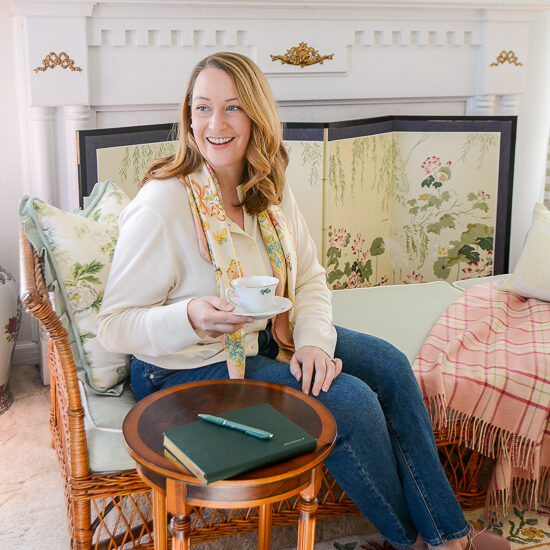
the curator, writer in residence, and decorator behind Pender & Peony.
I’ve decorated my entire 1960s brick colonial with secondhand finds and antiques on a budget without sacrificing style, quality, or comfort.
You CAN have a traditional home with timeless charm on a budget too!
The problem isn't your taste -- it's an industry that glorifies the next big trend and only showcases high end custom design.
That's why I created The Collected Room Method to teach you my approach to the collected interior!
Katherine, thank you for the lesson in Persian rugs. You have explained it with so much detail and understanding the process. I look forward to reading more on rugs.
Thank you!
Sharon (A British Lady Living in Ontario Canada)
Thanks Sharon! So glad you found this helpful. I enjoyed researching this piece!